
Digital Hydraulics
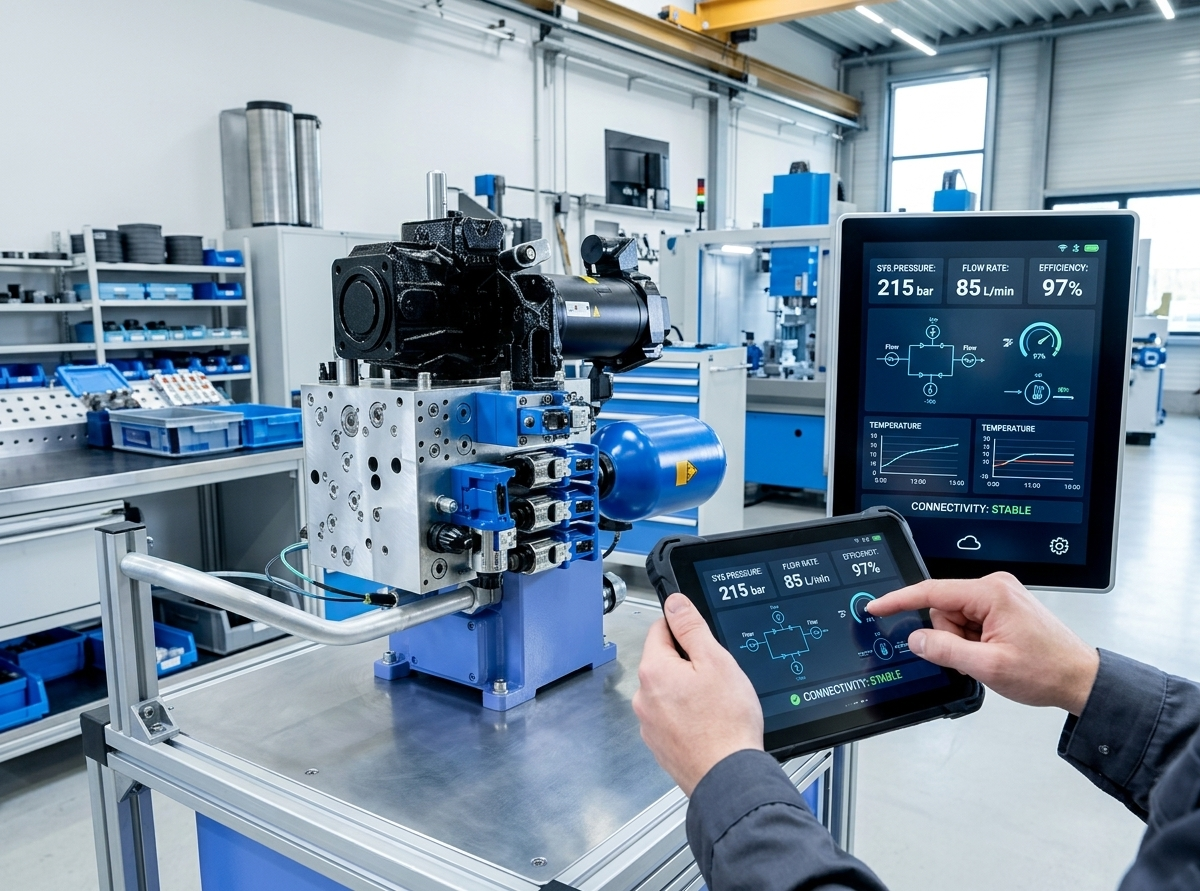
Introduction to Digital Hydraulics: Principles and Industrial Applications
In modern fluid power engineering, traditional hydraulic systems have long relied on analog, continuous-control components—such as proportional and servo valves—to regulate flow, pressure, and actuator position. **Digital Hydraulics** represents a paradigm shift in this domain, replacing sensitive analog components with discrete, binary-actuated (on/off) components driven by intelligent control algorithms.
Core Principles
Instead of utilizing a single valve with a continuously variable spool position, digital hydraulics employs arrays of fast-switching, on/off valves or digital displacement pumps. By switching these discrete valves in parallel combinations or utilizing high-frequency switching techniques (similar to Pulse Width Modulation in electronics), the system achieves highly precise control over the fluid’s flow and pressure.
Key Technical Advantages
High Contamination Tolerance:
Traditional servo valves have microscopic clearances and are highly susceptible to fluid contamination, often leading to jamming. Digital on/off valves have a much more robust mechanical design, significantly reducing the risk of failure due to oil particles and eliminating the need for extreme filtration.
Enhanced Energy Efficiency:
Analog proportional valves inherently suffer from continuous throttling losses (pressure drops across the valve edges). Digital hydraulics minimizes these losses. In particular, digital displacement pumps generate only the exact flow required by the load, drastically reducing energy dissipation and lowering overall power or fuel consumption.
Zero Internal Leakage:
Digital hydraulic systems frequently utilize poppet-type (seat) valves. Unlike spool valves, poppet valves provide zero internal leakage, which ensures superior load-holding capabilities and improves overall system stability and safety.
Precision and Repeatability:
The combination of millisecond-response switching valves and advanced microprocessor control ensures high accuracy. Because the control relies on discrete states rather than continuous mechanical positioning, the system’s repeatability remains high and is less affected by fluid temperature variations or mechanical wear over time.
Major Industrial Applications
Turbine Governors (Power Generation):
In hydro and steam turbines, digital hydraulics provides a highly reliable alternative to sensitive servo valves. It is used to control inlet guide vanes and critical fluid valves, ensuring uninterrupted operation and high reliability even in less-than-ideal fluid conditions.
Mobile and Mining Machinery:
Employed in heavy construction and mining equipment, primarily through digital displacement technology. It optimizes the power drawn from the internal combustion engine, significantly reducing fuel consumption and emissions.
Heavy Industrial Machinery:
Digital hydraulics is increasingly utilized in large-scale hydraulic presses, metal-forming equipment, and fatigue-testing machines. In these applications, the technology provides the necessary combination of precise force/position control, high energy efficiency, and extreme durability under heavy loads.
In summary, digital hydraulics is not merely an incremental upgrade but a fundamental redesign of fluid power architecture, bridging the gap between the raw force of traditional hydraulics and the precision and efficiency of modern digital electronics.